Your week
A Japanese university has already published what happens in week 11 of a class you have not enrolled in
Two ordinances set the shape of a Japanese university week, and between them they contradict three things that guides written in English say with confidence. The year does not have to begin in April. The class is not ninety minutes at a growing number of places. And most of the work that a credit is defined as does not happen in the room. All of this is published in advance, by the universities themselves, and some of it is published in English. We went and read a real Tuesday.
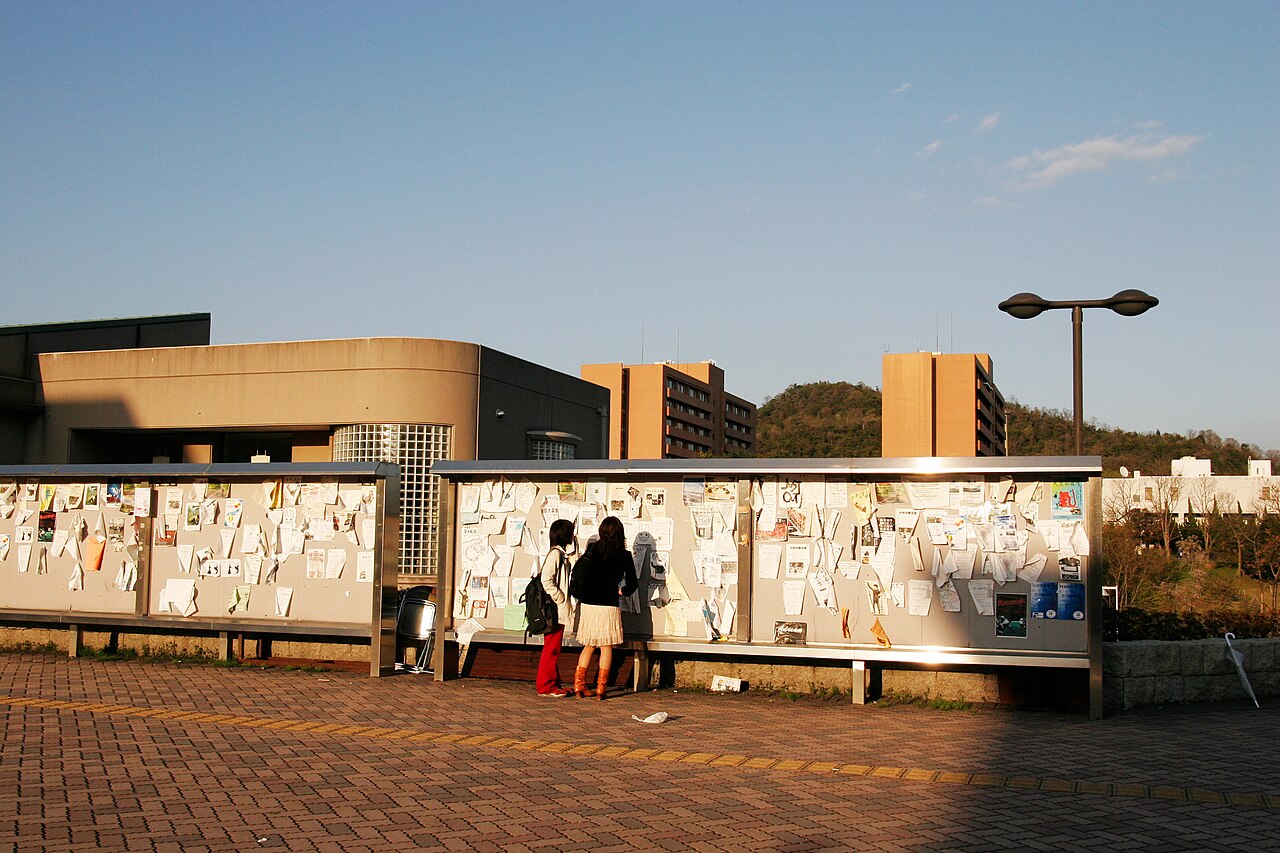
Somewhere on every Japanese campus there is a long glass case with paper taped inside it, and at four in the afternoon there are students standing in front of it finding out which room moved. That part of the week you cannot see from abroad. The rest of it — what each course covers in each of its weeks, how long a class runs, what share of your mark comes from turning up, what the university expects you to be doing when you are not in the building — is not hidden at all. Publishing it is a legal obligation. A surprising amount of it is in English, with no account and no application.
A real Tuesday
The University of Tokyo runs a public course catalogue. There is a language toggle in the corner. On 7 August 2026 we opened it, switched it to English, typed one word, and took the first result — not a curated example, simply the first thing the search returned.
It is a first-year seminar for science students, course code 31672, titled Introduction to Intelligent Software Engineering. Worth 2 credits. It runs in the S1 and S2 terms. It meets in the third period on Tuesday. Under "Language" it says: Japanese, English.
Then it lists the weeks. Not a description of the weeks — the weeks:
Week 1 — course guidance
Week 3 — introduction to the software landscape
Week 5 — artificial intelligence
Week 8 — cyber-physical systems (self-driving, robotics)
Week 11 — a bird's eye view of recent progress in academia and industry
Week 12–13 — group presentations
Abridged from the thirteen weeks listed. Retrieved 7 August 2026.
Then it tells you how you will be marked, to the percentage point. Participation and attendance 30%. Presentation 30%. Final report 40%.
Then, under "Notes on Taking the Course", it tells you the things that actually decide whether you can survive the room. That the lecture "would be mainly taught in English; please be careful during the course selection". That discussion may run in either language. That the class uses Slack, and — this is the line we liked — "please prepare a laptop or mobile during attending the lecture."
April is a habit. It is not the rule.
Every guide will tell you the Japanese academic year starts in April. Every guide is describing what happens, not what is required, and the difference matters if you are trying to arrive at a sensible time.
The Enforcement Regulation of the School Education Act does fix the year for schools. Article 59: "the school year of an elementary school begins on 1 April and ends on 31 March of the following year." That provision is applied onward to lower and upper secondary schools.
For universities it says something different. Article 163, first paragraph, in its entirety:
"The beginning and end of the school year of a university shall be determined by the president."
And the second paragraph: a university may admit students and graduate them partway through that year, in accordance with its division into terms.
学校教育法施行規則 第163条. Retrieved from the e-Gov statutory database, 7 August 2026.
So April is convention — a strong one, tied to the school system that feeds the universities and to the fiscal year — but it is not a statutory constraint on the university itself. That is why September entry exists in Japan without anyone having had to change a law for it, and why a Japanese university calendar has two starting lines on it rather than one.
Waseda University publishes its calendar in English. Spring semester: 1 April to 29 July. Autumn semester: 21 September to 2 February of the following year. Two semesters, two beginnings.
Thirty-five weeks, cut up differently in every faculty
The second ordinance is the Standards for the Establishment of Universities, which is where the machinery lives.
Article 22 sets the year: "the period during which classes are conducted in one year shall, as a principle, extend over thirty-five weeks."
Article 23 then declines to fix the course: classes for each subject are conducted "in units of eight weeks, ten weeks, fifteen weeks, or another appropriate period determined by the university."
This is why "semester" is not a portable word here. The University of Tokyo divides each semester into two terms — S1 and S2 in the spring, A1 and A2 in the autumn — and a course may occupy one term or both. The seminar above runs across both. A course beside it in the same catalogue may be finished in eight weeks.
The practical consequence: when you are working out whether a plan fits — a flight, a lease, a job, a visit home — the unit you need is not "semester". It is the term structure of the specific faculty, which is on that faculty's academic calendar, usually as a PDF, frequently in English.
The class is not ninety minutes any more
The ninety-minute class is the single most repeated fact about Japanese higher education in English, and at a growing number of universities it stopped being true several years ago.
Waseda moved to 100 minutes in the 2023 academic year, and moved the start of the day ten minutes earlier to fit it. Their current published times:
| Period | Waseda, from 2023 |
|---|---|
| 1 | 8:50 – 10:30 |
| 2 | 10:40 – 12:20 |
| 3 | 13:10 – 14:50 |
| 4 | 15:05 – 16:45 |
| 5 | 17:00 – 18:40 |
| 6 | 18:55 – 20:35 |
| 7 | 20:45 – 21:35 |
Six periods of a hundred minutes, and a seventh of fifty that runs until half past nine at night. The university's stated reason for the change is its own long-range plan — the extra ten minutes to support "dialogue-oriented, problem-finding and solving-type classes", and longer breaks between terms to make internships and study abroad easier to fit in.
The University of Tokyo does something more confusing and more honest. Its Komaba timetable booklet for the 2026 spring semester prints three tables of period times on one page, because three different lengths are in use in the same semester:
| Same campus, same term | Period 1 |
|---|---|
| Class hours (90 minutes) | 8:30 – 10:00 |
| Class hours (105 minutes) | 8:30 – 10:15 |
| Exam period (90 minutes) | 8:40 – 10:10 |
Note what this does to a plan. If you have worked out that you can hold an evening shift because the last class ends at six, you have worked it out from a table that may not be the table your faculty uses. Find the timetable of the actual faculty before you count on the gap. If the shift is the point, the hours you are allowed to work are a separate problem, and we have written about the twenty-eight hour limit elsewhere.
Where the other two-thirds of the work lives
Now the number that decides what the week feels like. Article 21 of the same ordinance defines what a credit is:
One credit is composed of content requiring 45 hours of study, as the standard. Of that, the class portion is set by the university within a range of roughly 15 to 45 hours, taking into account the teaching method, the educational effect, and the study required outside class hours.
大学設置基準 第21条第2項, paraphrased from the Japanese. Retrieved 7 August 2026.
Apply it to the Tuesday seminar. Two credits, so 90 hours of study is what the credit is defined as. Sitting in that room for 105 minutes, thirteen times, is about 23 hours on the clock — that multiplication is ours, from the published timetable and the published week list.
Whatever the accounting conventions behind the ordinance's range, the shape is not in doubt: the classroom is the smaller part of what a credit means. The rest is expected to happen somewhere else, and a full first-year load is not one course but ten or more of them.
This is the part that no brochure conveys and that the ordinance states plainly. It is also, we think, the most useful thing on this page for anyone estimating how much of the week is actually free.
Why any of this is public
None of the above is a leak or a courtesy. Article 172-2 of the Enforcement Regulation lists ten categories of information that a university must publish. Two of them are the ones that matter here.
Item 6 — the syllabus
"The subjects taught, the methods and content of teaching, and the annual teaching plan." That last phrase is the week-by-week list.
Item 7 — the marking
"The assessment of learning outcomes, and the criteria applied in certifying graduation or completion." That is where the 30/30/40 comes from.
The final paragraph of the same article says how: by publication, by use of the internet, or by other means capable of achieving wide dissemination. The obligation is to make it public, not to make it findable — which is roughly the state of things.
How to read your own week before you apply
Two systems we opened on 7 August 2026 with no account and no Japanese:
- The University of Tokyo course catalogue — catalog.he.u-tokyo.ac.jp. There is a JP/EN switch at the top. Search by keyword, filter by faculty, undergraduate or graduate. Course pages give the week list, the credit value, the language, the period, and the marking split.
- Waseda's syllabus search — wsl.waseda.jp/syllabus. Also open, also switchable to English.
For any other university, the search that works is the institution's name plus シラバス (shirabasu, syllabus) or the English word. Some put the whole thing in the open. Some publish an index in the open and keep the detail behind the student system.
Read the fields in this order. Method of evaluation first — it tells you what kind of course it really is, and whether attendance is scored. Then the week list, which tells you the pace. Then the notes at the bottom, which is where the language of instruction, the software, and the equipment you are expected to bring are hiding.
What this does not tell you
- It can change. The University of Tokyo's own catalogue carries a notice that class plans and classrooms are subject to change and that enrolled students should check the internal system for the current version. A published syllabus is a plan, not a promise.
- The public version is trimmed. That same catalogue states that URLs, accounts and classroom information have been removed from the public pages to avoid leaking internal details. You get the teaching, not the logistics.
- "Taught in English" is a claim, not a measurement. The seminar above says it will be mainly in English and that Japanese explanation will be added where the content is hard to follow. What that means in the room is not on the page.
- Two universities is not a country. We opened Tokyo and Waseda. They are large, well-resourced, and unusually open. The publication obligation applies to every university in Japan; the quality and the openness of what satisfies it does not.
- Nothing here is about people. A week list will not tell you whether the seminar is good, whether the teacher answers email, or whether you will make a friend in it. For the graduate-level version of this problem — reading what a laboratory actually produces — see the thesis rule.
Read next
Found a syllabus you cannot read?
Plenty of them are Japanese-only, and the interesting fields — the marking split, the notes at the bottom — are usually the last thing a machine translation gets right. Send us the link and the question. We will read it and answer from the page itself.
Ask one question →Free, once. No sales call afterwards.
The ordinances. Enforcement Regulation of the School Education Act (学校教育法施行規則), Ministry of Education Ordinance No. 11 of 1947 — Article 59 (school year of an elementary school), Article 163 (the beginning and end of a university's year are determined by the president; admission and graduation may occur partway through it by term) and Article 172-2 (the ten categories of information a university must publish, including item 6, subjects, teaching methods and content, and the annual teaching plan; and item 7, assessment of learning outcomes and the criteria for certifying graduation; with paragraph 5 permitting publication by internet). Standards for the Establishment of Universities (大学設置基準), Ministry of Education Ordinance No. 28 of 1956 — Article 21 paragraph 2 (one credit composed of content requiring 45 hours of study as the standard, with the class portion set by the university within roughly 15 to 45 hours, accounting for study required outside class), Article 22 (35 weeks of teaching a year as a principle) and Article 23 (courses conducted in units of 8, 10, 15 weeks or another period the university determines). Both retrieved from the e-Gov statutory database on 7 August 2026 (Standards here). Translations of the quoted passages are ours; the ordinances are authoritative only in Japanese. The course. University of Tokyo course catalogue, course code 31672, academic year 2026, retrieved 7 August 2026. The week list is abridged; the credit value, period, languages and the 30/30/40 evaluation split are quoted as published. We have no connection to the course, the teacher or the faculty — it was the first result for a single keyword and is used because it is ordinary. Class times. Waseda University, academic calendar and class hours (English), and the university's 2022 announcement of the change from 90 to 100 minutes effective from the 2023 academic year, from which the stated reasons are quoted. University of Tokyo, College of Arts and Sciences, Syllabus and Timetables, S Semester 2026 (PDF, English), from which the three period tables are taken. All retrieved 7 August 2026. Our arithmetic. "About 23 hours" is 105 minutes multiplied by the thirteen weeks listed in that catalogue entry. It is our calculation from published figures, not a published figure, and it takes no position on how the ordinance's 15-to-45-hour range is counted in practice — a technical question we have deliberately not tried to settle here. What this article is not. A description of published documents and how to find them. Not advice on admissions, and not a statement about the quality of any course, faculty or university named.